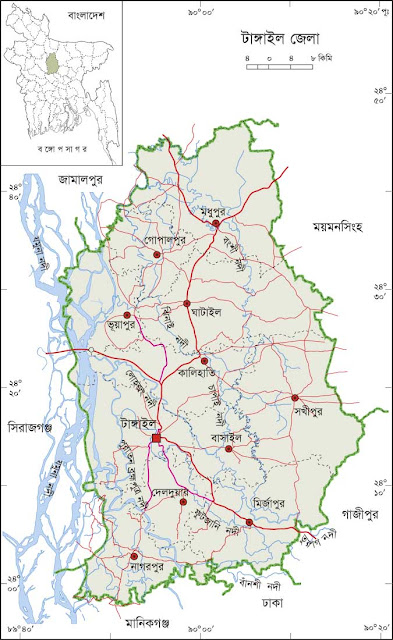
Tangail District
Tangail is a district (zilla) in central region of Bangladesh. It is a part of the Dhaka division. The population of Tangail zilla is about 3508556 and its surface area is 3,375 km2. The main town of Tangail District is the district town Tangail. It is surrounded by the several districts, such as Jamalpur district on the north, the Dhaka and Manikganj districts on the south, the Mymensingh and Gazipur districts on the east, and the Sirajganj district on the west. The main rivers that cross the Tangail district are the Jamuna, Dhaleshwari, Jhenai, Bangshi, Lohajang, Langulia, Elongjani, Jugni, Fotikjani and the Turag.
The subdivision of Tangail was established in 1870. It was turned into a district on December 1, 1969. The district consists of 5 corporations, 8 municipalities, 72 wards, 211 mahallas, 103 union parishads and 2431 villages. Tangail is subdivided into 12 subdistricts (upazila/thana). The name of the upuzilas are: Tangail Sadar, Sakhipur, Basail, Madhupur, Ghatail, Kalihati, Nagarpur, Mirzapur, Gopalpur, Delduar, Bhuapur and Dhanbari.
Agriculture is the main occupation of the Tangail district. About 49.53% people are involved with agricultural activities. Its main agricultural products are paddy, potato, jute, sugarcane, sesame, linseed, wheat, mustard seed and pulse. About 2800 km2 Cultivable lands are abundant in Tangail. The primary fruits produced here are mangoes, jackfruit, bananas, litchis, and pineapples. Other sectors, such as fisheries (446 units), dairies (189 units), industries, weaving, and poultry farms (538 units), are also flourishing in the district. Tangail is the home of the world-famous 'Tangail Saree,' a traditional handloom saree made of cotton and silk. These sarees feature intricate hand-worked 'butti' designs, floral patterns, or contemporary motifs, and are highly valued by women of Bangladeshi and Indian origin worldwide. The Tangail Saree remains the most popular among all varieties. Following the 1947 partition, some weavers migrated to India. Haridas Basak, a leading saree merchant in Tangail, helped these weavers settle in Fulia, Samudragarh, and Dhatrigram in West Bengal; notably, his original saree shop still exists in Tangail.
Heritage of Tangail
☛ Porabari Cham-Cham
☛ Tangail Tater Saree
☛ Household utensils made of bell metal
☛ Madhupur Pineapple
☛ Seetal Pati (Hinganagar Village)
☛ Bananas (Madhupur gor)
☛ Jackfruit(Madhupur,Ghatail)
☛ An old tree named Tomal at Gupta Brindaban, Ghatail.
☛ Shal/Gojari Bon (Madhupur,Shakhipur & Ghatail).