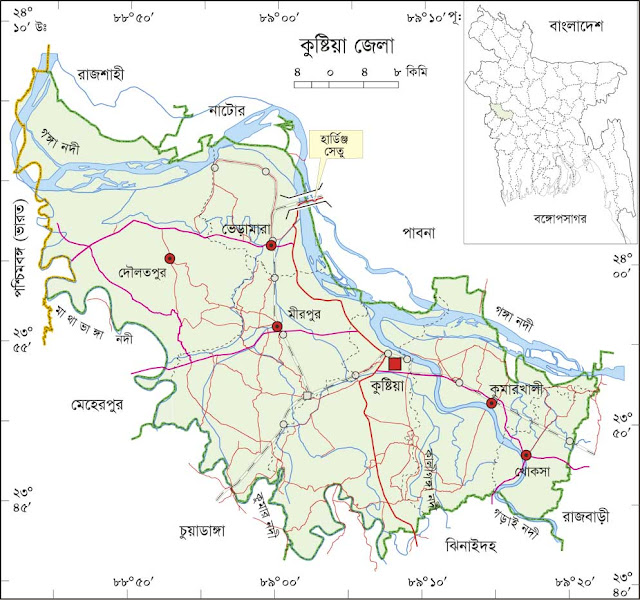
Kushtia, Kushtia district or Kushtia Zila is a district in the Khulna administrative division of western Bangladesh. Kushtia has existed as a separate district since the partition of India. Prior to that, Kushtia was a part of Nadia District under Bengal Province of British India. Kushtia was home of many famous people, especially authors and poets. Present day Kushtia is known for the Islamic University, Shilaidaha Kuthibari and Lalon's shrine.
Kushtia District has an area of 1621.15 square kilometres and is bounded by Rajshahi, Natore, Pabna districts to the North, by Chuadanga, Jhenaidah districts to the South, by Rajbari District to the East, and by West Bengal and Meherpur District to the West.
Ganges, Garai, Mathabhanga, Kaliganga, and Kumar are the main rivers flowing through the district. The average high temperature is 37.8 °C and the average low is 11.2 °C. Annual rainfall averages 1,467 millimetres.
The district of Kushtia made a significant contribution to the Bangladesh Liberation War. A 147-member company of the 27th Baluch Regiment of the Pakistan Army reached Kushtia on 25 March 1971 from its base at Jashore Cantonment. Although they initially captured the local police station and established an outpost, they soon faced fierce resistance from the police, Ansars, students, and local citizens. By April 1, the Pakistan Army was completely overpowered, and the Muktibahini took control of Kushtia. Later, on April 17, 1971, the Bangladesh Government-in-exile formally announced the Proclamation of Independence at Baidyanathtala (renamed Mujibnagar), a border area in the present Meherpur district, which was then a subdivision of Kushtia. This Proclamation served as the fundamental instrument of law and the interim constitution of the Mujibnagar Government during the war. Historically, Greater Kushtia comprised three subdivisions—Kushtia, Chuadanga, and Meherpur—all of which are now independent districts. The inhabitants of these regions, formerly part of the undivided Nadia district, speak a dialect remarkably close to the 'standard' Bangla used in both West Bengal and Bangladesh.
Cultural organizations-
From the very beginning,Kushtia was called the center city of Art &; Music in Bangladesh. In that small town they have around 26 Public libraries, playground 115, club 204, sangit college 1, women's organisation 25, jatra party 2, theatre group 11, theatre stage 5, shilpakala academy 1, children's academy 1, cinema hall 16, literay society 34, community centre 3.
Administration:
Kushtia was established as a district in 1947 following the partition of India and the creation of East Pakistan (now Bangladesh). Initially, the district comprised the Kushtia Sadar, Chuadanga, and Meherpur subdivisions. For administrative convenience, these subdivisions were later upgraded to independent districts in 1984. Currently, Kushtia district consists of six upazilas and seven police stations (including the Islamic University Thana). It also includes five municipalities, 57 unions, 710 mouzas, and 978 villages. The six upazilas are Kushtia Sadar, Kumarkhali, Daulatpur, Mirpur, Bheramara, and Khoksa.
Demographics
Kushtia District has a population of 13,324, of which 50.86% are male and 49.14% female. In terms of religion, 95.72% dwellers of Kushtia are Muslims, 4.22% follow Hinduism and others religions make up 0.06%.
Places of interest
One of Rabindranath Tagore's dwellings, the Kuthibari, is located at Shilaidah in Kumarkhali Upazila of the Kushtia district. He lived here for part of his life, and wrote many memorable poems there. Tagore built the Kuthibari as his office/residence, to collect revenue as a Zaminder, from local peasants. The Kuthibari is now a museum, and is cared for by the Archaeological Department of Bangladesh.
The shrine of Lalon Fakir, the founder of the Baoul faith is located at Cheouria, about 2 km from the Kustia railway station.
Engr Quamrul Islam Siddique founded the Local Government Engineering Department (LGED) to its present status from a simple and negligible works programme wing of the Ministry of Local Government, Rural Development and Cooperatives (LGRD &; Cooperatives). There was no high school within 6 km area of Boria village of Sadar Upazila in Kushtia and no education for the girls. In Jan, 1995, as approved by the Government, Begum Hamida Siddique Collegiate School (BHSCS) in Boria, Kushtia was established with the support of Late Engr. Quamrul I. Siddique (QIS).
Economy
Kushtia produce a large number of rice in Khajanagor by Auto rice Mill(Rashid Auto Rice Mills),It has also a big commercial area named BISIC SHILPONOGORY, BRB is one of its famous brand and a Tobacco Factory(British American Tobacco Company).