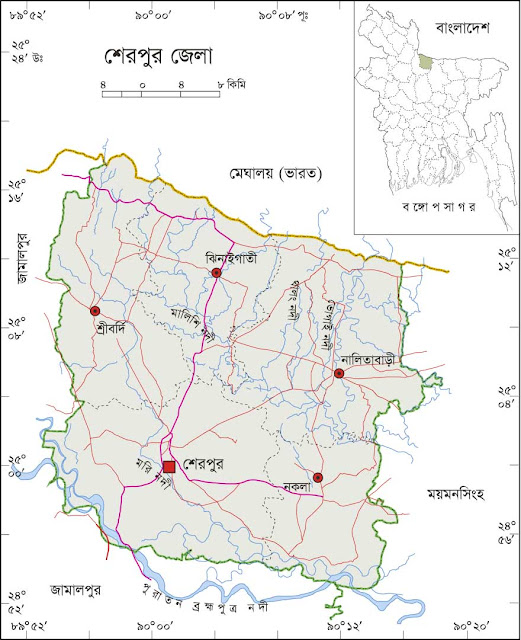
Sherpur District
Sherpur district city stands on the bank of the Mrigi and located at 25°00'00"N 90°01'00"E / 25.0000°N 90.0167°E. It was established in the seventeenth century. It was declared as a district on 24th February 1984. It consists of five Upazilas, four Pourasavas (Municipality) and fifty-two Unions. Sherpur district has a strong history and heritage in diversified culture with indigenous Garo and Hajang people. During the Mughal period, a Regional Administrative Centre was established in Sherpur. City Magistrate Court and Thana (Police Station) were established in the beginning of the nineteenth century. The Sherpur Municipality was established in 1869. The Telegraph Office and the Munsif Court were established in 1885 and 1887 respectively. Queen Victoria Memorial Academy, now well-known as Sherpur Government Victoria Academy, was established in 1887 and Govinda Kumar Peace Memorial Institute was established in 1919. Sherpur Shahid Moktijoddha stadium was established in 1997. The district is adjacent to the Indian Meghalaya Border and within the Garo hilly region of Bangladesh. It is renowned for some of the tourist resorts like Gajni Abakash Kendra and Modhutila Eco-Park for its hill view. Sherpur is a food surplus area of Bangladesh; moreover, Nazir-Shail and aromatic rice production are more remarkable than other districts of Bangladesh. The intercommunication system of the district has enormously developed in the last three decades, as a result, most of the villages are accessible by Jeep. There are some prominent rivers in this district, such as Bhogai, Brahmaputra, Moharashi, Malijhi, Mrigi etc. It is a flash flood prone area, as a result, habitants of this district face this challenge every year. Sherpur is famous for sweetmeats made from milk; local people call these Shnar Payesh, Monda, and Malaichop etc. Sherpur has a land-port at Nakugaon under Nalitabari Upazila. Sherpur is one of the potential districts in Bangladesh in all respects.